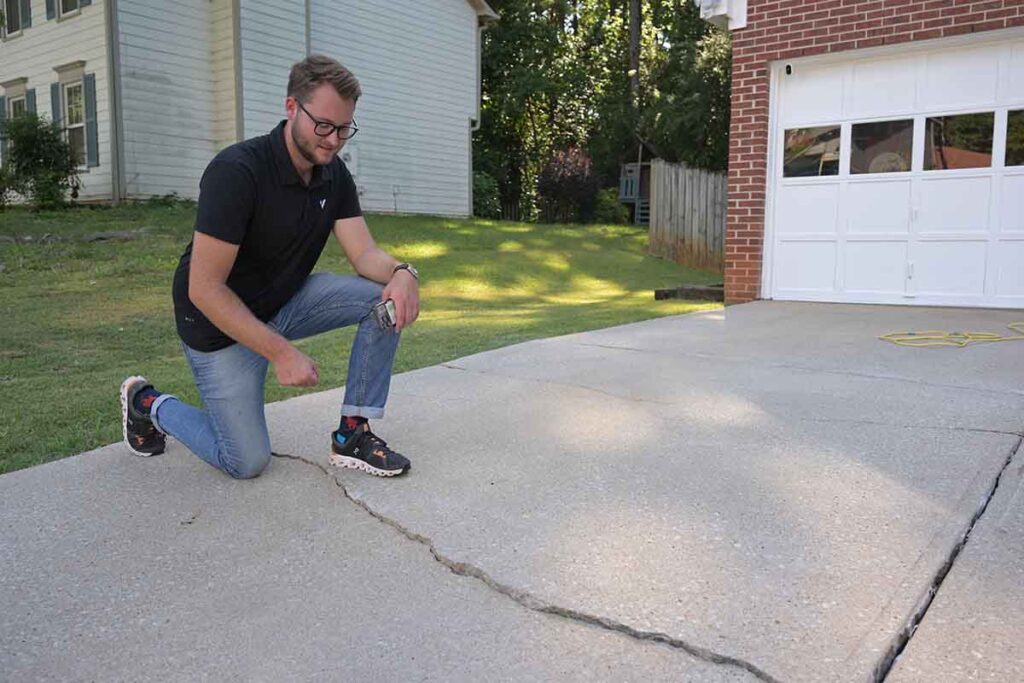
A sunken driveway and a foundation problem are not the same thing, and they do not get fixed the same way. The fastest way to tell them apart is to ask one question. Did a piece of concrete move, or did the house move?
If the concrete outside has dropped while the house sits where it always has, you are looking at a settled slab. If doors inside have started to stick, floors feel like they slope, or cracks are climbing the interior walls, the structure is involved. That is work for a foundation contractor or a structural engineer. We level concrete at Signature Polyjacking. We do not do foundation repair, so sorting out which problem you actually have is the first thing we do on any visit.
Here is how to read the signs yourself before anyone comes out.
What Is the Difference Between a Sinking Slab and a Foundation Problem?
A slab is a flat piece of concrete poured on the ground. Your driveway, your sidewalk, your patio, your garage floor, and the steps at your front door are all slabs. Nothing holds them up except the soil underneath. When that soil erodes, compacts, or washes out, a gap opens and the slab drops into it. The concrete itself is usually fine. The support under it is not. That is the whole job of concrete leveling and lifting.
A foundation is the structural base the house is built on. Footings, stem walls, and piers carry the weight of the building. When a foundation moves, the house moves with it, and the repair means underpinning or structural work rather than filling a void. Different problem, different trade.
Why Does Concrete Sink in Metro Atlanta?
Most of Metro Atlanta sits on red clay, and clay holds water. It swells after a wet week and shrinks back through a dry stretch, year after year. Concrete poured over clay rides that movement.
Three things speed it up:
- Water with nowhere to go. Downspouts that empty beside a slab, or a yard that drains toward the house, carry fine soil out from underneath.
- Fill that was never compacted. Builders backfill trenches and low spots before the pour. Loose fill keeps settling for years after the house is finished.
- Tree roots. Roots pull moisture out of the soil around a slab, and a large root can push one side of it up.
Our longer piece on what makes slabs settle covers each of these in more detail.
Which Signs Point to a Settled Slab?
Every one of these describes concrete that moved while the house stayed put:
- One section of driveway sitting lower than the section beside it.
- A sidewalk panel that has dropped at the joint, leaving a lip you can catch a shoe on.
- Water pooling on a patio or garage floor where it used to run off.
- A gap that has opened between the front steps and the house.
- Concrete that sounds hollow when you tap it, which usually means there is a void under it.
- Doors and windows inside the house still opening and closing normally.
That last one carries a lot of weight. If the inside of the house is behaving, the problem is almost always outside and under the concrete. Uneven walkway edges are the version of this we get called about most.
Which Signs Point to a Foundation Problem?
These describe a house that moved:
- Interior doors that stick, swing open on their own, or stop latching.
- Floors inside that slope or feel bouncy underfoot.
- Cracks running diagonally out from the corners of interior doors and windows.
- Stair step cracking through brick or block on an exterior wall.
- Gaps opening between a wall and the ceiling or the baseboard.
- A basement or crawl space wall that bows inward.
If that list sounds like your house, the right next call is a foundation repair company or a structural engineer. We will tell you the same thing if we come out and find it, and we will not sell you a slab lift that would not solve the problem.
Why the Two Get Mixed Up
Both problems show up as cracked, uneven concrete, and both get worse in the same weather. Someone standing on a cracked driveway has no easy way to know whether the cause is two feet down or ten.
A garage floor is the case that confuses people most, because it is a slab sitting inside the footprint of the house. A dropped garage floor is usually a soil problem, and garage floor leveling is the fix. If the walls around it have shifted as well, the cause is somewhere else and a slab lift is not the answer.
How Is a Settled Slab Repaired?
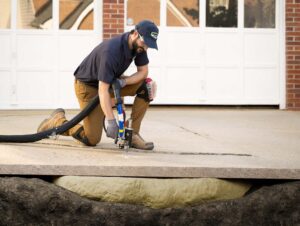
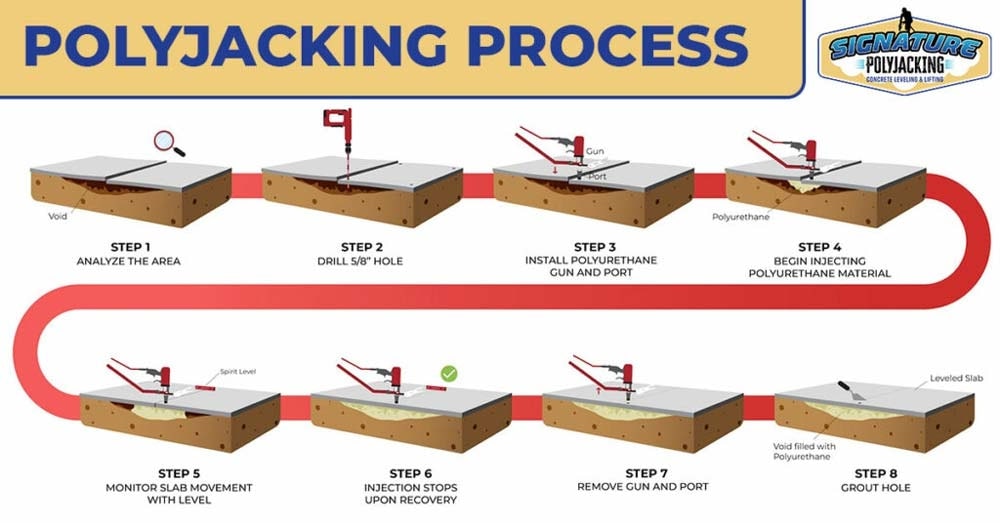
Polyjacking treats the soil, not the concrete. Small ports are drilled through the slab, foam is injected underneath, and it expands to pack the empty space and raise the slab back toward grade. The ports are patched when the lift is finished. You keep the concrete you already have, and there is no tear out.
Two related jobs often travel with it. Filling the voids first stabilizes ground that has washed out, even where there is little height to recover. Sealing the joints afterward keeps surface water from running straight back into the soil you just paid to fix.
Where a slab has been pushed up by a tree root rather than dropped, lifting is the wrong tool entirely. Grinding the high edge down removes the trip hazard instead, and it is the cheaper option when it applies.
What Concrete Leveling Can and Cannot Do
Being straight about this saves everyone time.
It can close the void under a slab, raise the slab back toward its original height, stop the rocking and the puddling, and take out a trip hazard. Most residential jobs are handled without removing any concrete.
It cannot make a slab perfectly level. When we describe concrete leveling, we are describing the method used to stabilize and, in many cases, raise uneven or cracked concrete using polyurethane foam. We cannot guarantee that the process will result in perfectly level concrete, and we will tell you what is realistic before we start.
It also cannot repair a foundation, replace concrete that has broken into pieces, or correct the drainage that caused the settling. Drainage is separate work, and it is worth handling, because water is what moved the soil in the first place.
Still Not Sure Which One You Have?
Take two photos. One of the slab from a low angle, so the drop is visible against something that has not moved. One of the seam where the concrete meets the house. Those two pictures answer the question most of the time.
If it is a settled slab, we can look at it and price it at no cost. If the signs point to the foundation instead, we will say so and point you toward the right trade. We would rather tell you it is not our job than sell you a repair that does not fix it.