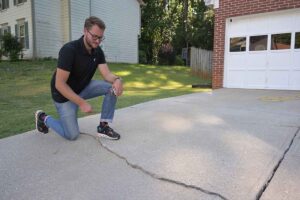
Let’s Clear Something Up: Not All Concrete Problems Need a Sledgehammer
If you live in Sandy Springs long enough, your concrete will eventually do the same thing most of us do after a few decades…settle, sag, and start complaining. Driveways crack. Pool decks dip. Sidewalks turn into trip hazards. And somewhere in that mess, you’re left trying to decide whether to lift that concrete or replace it outright.
We get it. It’s a common question. And if concrete could talk, it would probably ask the same thing.
So today, we’re breaking it down for you, in plain talk. Consider this a friendly walk-through of your options.
For more information, see Should I Repair, Resurface, or Replace My Concrete Driveway?
Why Concrete Sinks in the First Place
Before comparing concrete lifting to concrete replacement, let’s talk about why your concrete is misbehaving. In Sandy Springs, we’ve got a few usual suspects:
- Georgia’s clay-heavy soil: It swells when wet and shrinks when dry.
- Poor drainage: Water erodes soil under slabs.
- Shifting ground: Soil settles unevenly, leaving your concrete hanging in midair.
- Poor compaction during installation: The slab never had the support it needed.
Whatever the cause, the result is the same: concrete that’s no longer level, stable, or safe.
Now you’re stuck choosing between two paths: tear it out, or lift it up.
Let’s compare.
Path 1: Concrete Replacement
When you want the nuclear option.
Replacement is exactly what it sounds like: we break up the existing slab, haul it away, re-prep the ground, and pour new concrete.
Sounds straightforward, but here’s what most homeowners don’t realize.
Note: Signature Polyjacking does not perform concrete replacement. When replacement is the best option, we can help you connect with trusted local contractors.
Replacement Is Loud, Messy, Expensive, and Slow
Concrete replacement:
- Involves heavy demo tools
- Leaves a muddy excavation behind
- Requires curing time (days or even weeks)
- Costs far more than lifting
- Doesn’t fix underlying soil problems
- Creates significant downtime
And remember, Georgia clay doesn’t care if your slab is “new.” If the soil moves again, that new concrete is going to crack just as fast.
When Replacement Is the Right Choice
We’re honest folks, and we’ll tell you straight: Sometimes replacement is the only option. That’s usually when:
- The slab is broken into multiple pieces
- The concrete has deteriorated beyond repair
- The structure is unsafe
- The slab is too thin or poorly poured
If the slab is more “crumbled cookie” than “concrete,” lifting won’t save it.
But most slabs? They’re levelable, patchable, and salvageable.
Which brings us to option #2…
Path 2: Concrete Lifting (Polyjacking)
The smarter, cleaner, faster way to restore concrete.
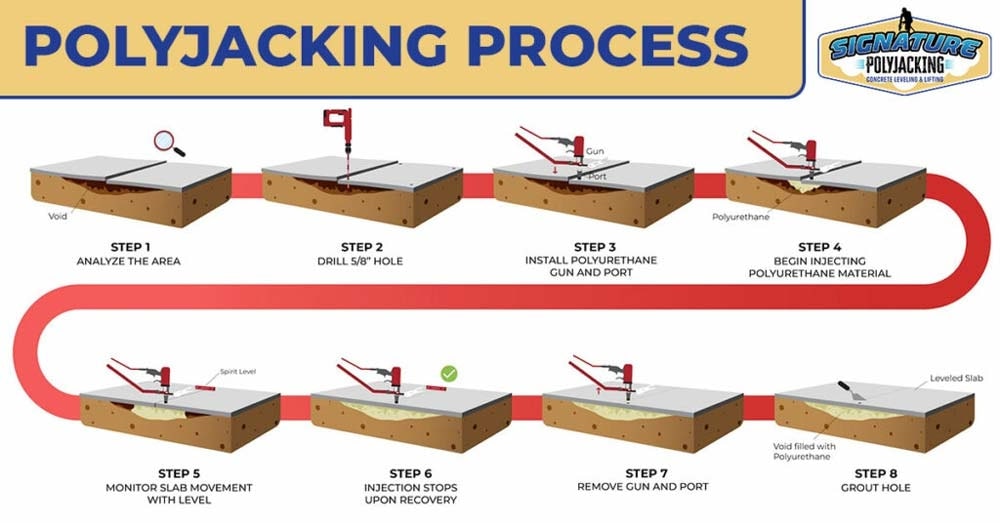
Concrete lifting – specifically polyjacking – is a modern method that raises sunken slabs by injecting high-density expanding foam underneath. That foam fills voids, stabilizes the soil, and lifts the slab back into place.
Think of it like giving your concrete a helping hand instead of a total makeover.
Why Homeowners in Sandy Springs Love Polyjacking
Here’s the real talk: concrete lifting wins the cost-and-durability contest almost every time.
1. It’s far more affordable
Lifting a slab can cost up to 70% less than replacing it. Less labor. Fewer materials. No disposal fees. No concrete trucks.
2. It’s fast, like “drive on it in 15 minutes” fast
Polyurethane foam cures quickly. You’ll be able to use your newly leveled slab right after we leave.
3. It’s clean and minimally invasive
We drill holes the size of a dime, not the size of a toddler’s fist like mudjacking. And we don’t have to tear up your yard.
4. It strengthens the soil instead of stressing it
Polyurethane foam expands into every tiny void beneath your slab, creating a stable base.
5. It’s long-lasting and weather-resistant
Foam doesn’t:
- Wash away
- Rot
- Shrink
- Attract moisture
- Add extra weight to already weak soil
6. It’s the sustainable choice
You’re not throwing out tons of concrete or creating landfill waste.
You’re restoring what you already have.
But Wait, What About Mudjacking?
Mudjacking is the old-school way of lifting concrete, using a heavy cement slurry. We don’t use it. Why? Because mudjacking:
- Uses bigger holes
- Adds more weight
- Washes out over time
- Doesn’t hold up in Georgia’s rainy weather
Polyjacking is the mudjacking alternative homeowners trust.
Cost Comparison: Lifting vs Replacement
Every job is different, but generally:
Concrete Lifting (Polyjacking)
- Fast
- Clean
- Affordable
- Durable
- Environmentally friendly
- Ready for use immediately
Concrete Replacement
- Higher labor costs
- Heavy demolition
- Longer downtime
- Higher material cost
- Vulnerable to future settling
If your concrete is structurally sound but sunken or uneven, lifting wins by a mile.
Durability Comparison
Let’s talk long-term:
Polyjacking Durability
- Foam lasts indefinitely
- Resistant to erosion
- Won’t break down with water
- Supports heavy loads
- Stabilizes the soil
- Prevents future sinking
Replacement Durability
- New concrete cracks
- Soil problems remain
- High chance of re-settling
- More maintenance over time
Unless the slab is too far gone, lifting gives you better durability with less downtime and lower cost.


Which Option Is Better for Sandy Springs Homeowners?
Sandy Springs has a few special considerations:
Clay-rich soil – Georgia clay is temperamental. Polyjacking stabilizes it better than replacement.
Heavier rainfall patterns – Foam is waterproof. Replacement concrete isn’t protected from erosion.
Mature trees – Roots love pushing up fresh concrete. Lifting avoids that issue.
Older neighborhoods – Many slabs have settled slightly over time…perfect candidates for lifting.
When Lifting Is Definitely the Better Choice
We recommend concrete lifting if:
- The slab is solid but sunken
- You want a fast, affordable repair
- You care about sustainability
- You want to prevent future sinking
- You don’t want your yard torn up
This includes:
- Driveways
- Sidewalks
- Patios
- Pool decks
- Garage floors
- Basement slabs
- Steps
If it’s concrete and it moved, we can lift it.
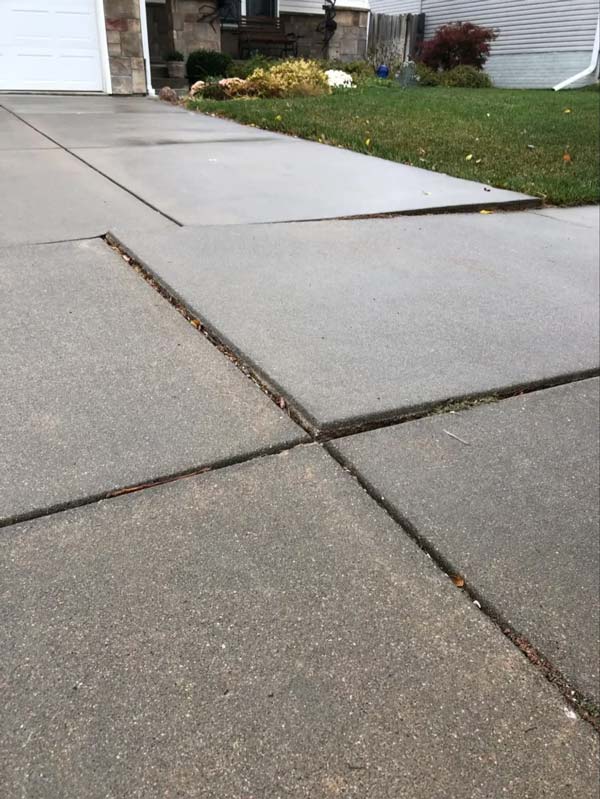
When Replacement Makes More Sense
Replacement is best if:
- The slab is shattered or crumbling
- Surface damage is severe
- The slab is less than 3 inches thick
- There’s major structural failure
If the slab can’t hold its own weight, lifting isn’t the right fix.
So, Lift or Replace? Here’s the Truth.
If your concrete can be lifted, it should be lifted. It’s cheaper, faster, cleaner, more durable, and more sustainable.
Replacement is the last resort, not the default. And if you’re unsure, we’ll take a look and tell you straight.
Your Next Step: Let’s Take a Look
Whether your concrete needs a gentle nudge or a full replacement, we’ll help you figure it out the honest way.
If you’re in Sandy Springs or anywhere in the Atlanta metro area, we’re right around the corner.
Schedule your free concrete assessment with Signature Polyjacking today.
We’ll show you the best option, without pressure, without upselling, and without the mess.